
Integrations
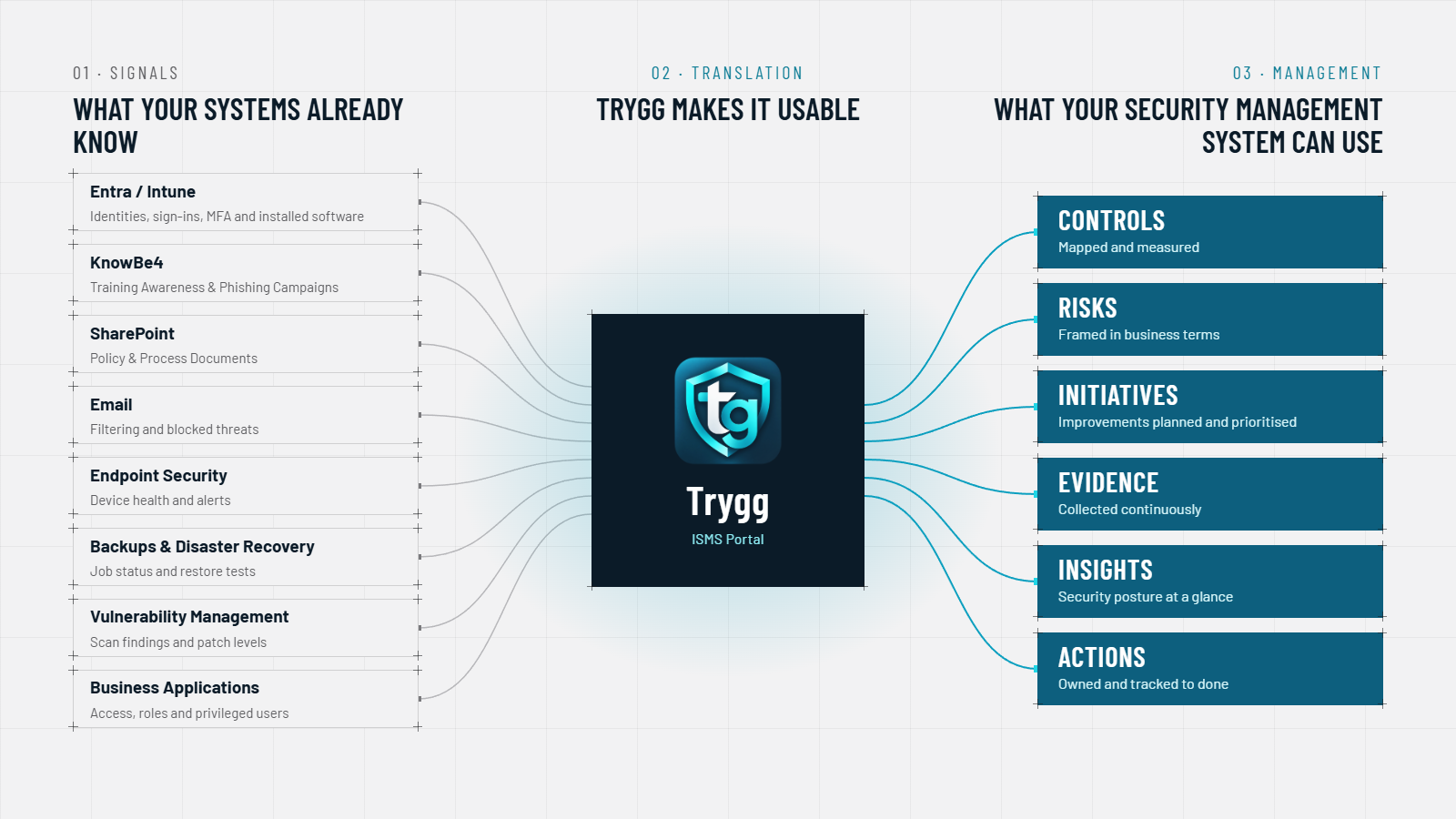
Connect the Management System to the Systems Running Your Business
Your organization already has systems that know a great deal about how your business operates and how it is being protected.
Your identity platform knows who your users are.
Your security awareness platform knows who completed training.
Your endpoint platform knows which devices are protected.
Your email environment knows how communication is being secured.
Your collaboration platform contains policies, processes, documents, and other important information.
Your business applications know who has access and, in many cases, what level of access they have.
Trygg integrations bring that information into the management system so you do not have to continually recreate it by hand.
The objective is simple:
If a trusted system already knows the answer, use the system.
No topics match that search.
Automation You Can Depend On
Information security management creates a lot of information.
People join and leave the company.
Applications are added.
Permissions change.
Training is completed.
Devices appear and disappear.
Vulnerabilities are discovered.
Policies are updated.
Evidence becomes outdated.
A management system built entirely around manual updates begins becoming inaccurate the moment the information changes.
Trygg uses integrations and automation to reduce that gap.
Where reliable information can be obtained from the system responsible for it, we want the management system to use that information.
That means less time collecting data and more time understanding what the data is telling you.
Microsoft Entra
Identity is one of the most important sources of operational security information.
Integrating with Microsoft Entra can help Trygg understand users, accounts, authentication, access, and other identity related information available within the customer's environment.
That information can support master data, security insights, control evidence, and the identification of conditions that may require attention.
Instead of periodically asking for a spreadsheet of users, the management system can reference the identity platform the organization is already using.
That creates a more current picture of the people and identities the organization needs to manage.
KnowBe4
Security awareness becomes much more useful when completion and participation can be measured.
Integrating with KnowBe4 allows relevant training information to become part of the management system rather than requiring someone to manually recreate training records.
Trygg can use available information to help show who has completed required awareness activities, where follow up may be needed, and whether training objectives are being achieved.
Training becomes more than an annual task.
It becomes another measurable part of the security program.
Microsoft SharePoint
Organizations already have years of valuable information.
Policies.
Procedures.
Process documentation.
Meeting records.
Security documents.
Project information.
Evidence.
Trygg does not need to pretend that information does not exist simply because it was created somewhere else.
SharePoint integration can help connect existing organizational information to the management system and reduce unnecessary duplication.
The objective is not to move every document into Trygg.
It is to make sure the right information is available where it provides value.
Email and Mail Security
Email is both a critical business service and a significant security consideration.
Trygg can use information available from connected email and mail security environments to help evaluate security conditions and support relevant controls.
That information can contribute to insights around how email is protected and whether expected security measures remain in place.
The email platform continues doing what it does best.
Trygg connects relevant results to the management system.
Endpoint Security
Your endpoint security platform may already know whether devices are protected, whether security agents are operating, and where gaps exist.
Trygg can use available endpoint information to bring those conditions into the larger security picture.
This helps connect technical results to controls, ownership, risk, and action.
A security administrator may need the detailed technical console.
Leadership needs to know whether the expected protection is operating and where attention is required.
Trygg helps connect those two perspectives.
Vulnerability Information
Finding vulnerabilities is important.
Knowing what they mean to the organization is more important.
Integrations with security and technology platforms can help bring vulnerability information into Trygg so it can be evaluated in the context of the systems, risks, owners, and business activities it may affect.
The objective is not to replace specialized vulnerability management technology.
It is to make sure important findings do not remain isolated inside another tool.
A vulnerability should be able to lead to an owner, an action, and ultimately evidence that the issue was addressed.
Backup and Recovery
A backup policy tells you what should happen.
The backup platform can help tell you what did happen.
Where supported, Trygg can use information from backup and recovery platforms to provide operational insight into whether expected backup activities are occurring.
That information can support control evidence and help identify conditions requiring attention.
Leadership does not need to administer the backup platform.
It does need confidence that critical information is being protected and visibility when expectations are not being met.
Master Data Refresh
Master data changes continuously.
Employees join and leave.
Roles change.
Applications are introduced.
Vendors change.
Technology changes.
Locations change.
Responsibilities move.
Integrations allow Trygg to reduce the amount of information that depends entirely on someone remembering to update it.
Where an authoritative source exists, that source can help keep relevant Trygg information current.
This improves more than convenience.
Better master data creates better risk decisions, better ownership, better reporting, and better evidence.
Software Inventory and Scoring
Knowing what software the organization uses is increasingly important to understanding security risk.
Trygg can use integration and automation to help identify software titles, organize applications, and support evaluation of the security considerations associated with them.
Applications can be understood in context.
What is the application used for?
Who owns it?
Who uses it?
What information does it contain?
Is it approved?
Does it involve artificial intelligence?
Does it have elevated access?
What security information is available about the provider or product?
Trygg can bring those considerations together to help organizations make more informed decisions about the software they depend upon.
A software inventory becomes more useful when it helps answer more than:
What do we have?
It should also help answer:
What should we know about it?
Evidence That Refreshes
One of the biggest opportunities created by integration is changing the way organizations think about evidence.
Traditional evidence is often a snapshot.
Someone takes a screenshot, exports a report, saves it in a folder, and presents it months later during an audit.
The screenshot may prove what was true on the day it was captured.
It does not necessarily tell you what is true today.
Where integrations allow it, Trygg can connect controls to operational information and show when that information was last refreshed.
That creates a different conversation.
Instead of asking:
When did we last collect evidence?
You can begin asking:
What does the evidence tell us right now?
From Integration to Insight
Collecting data is not the objective.
Understanding it is.
Trygg integrations are designed to move information through a useful path:
SOURCE SYSTEM → DATA → CONTROL → INSIGHT → ACTION → EVIDENCE
A source system tells us something.
Trygg connects that information to the management system.
The result may demonstrate that a control is working.
It may identify a gap.
It may create or influence a risk.
It may require someone to take action.
It may provide evidence for an auditor.
That is when an integration becomes more than a connection between two applications.
It becomes part of operating the security program.
Technology Changes. Integrations Should Too.
No customer uses exactly the same technology stack.
And the technology a customer uses today may not be the technology they use tomorrow.
Trygg is designed with that reality in mind.
We continue to evaluate integrations based on the systems our customers use, the information those systems can provide, and the value that information can bring to the management system.
Sometimes that means building a direct integration.
Sometimes it means using an available API.
Sometimes automation provides the better answer.
And sometimes the right approach is simply to leave a system doing what it already does well.
The objective is not integration for the sake of integration.
The objective is better information with less manual work.
Have a System We Should Connect?
Some of the best integration ideas will come from our customers and partners.
If an important part of your security program lives inside a system Trygg does not currently connect with, tell us.
We want to understand what the system knows, why that information matters, and how connecting it could improve your management system.
The question we will always ask is:
Will this connection help you understand, operate, demonstrate, or improve your security program?
If the answer is yes, it is worth a conversation.
Connected by Design
A management system should not become another isolated application your team has to maintain.
It should benefit from the technology, information, and processes already operating around it.
That is what integrations make possible.
Connect what you already use.
Automate what should not be manual.
Surface what needs attention.
Keep the evidence current.
Turn information into action.
When a connected system shows a gap, you and Trygg are looking at the same item, who owns it, and whether the evidence date moved.